
AI Content Gap Analysis
Contents
In the unrelenting, fast-paced world of digital marketing, relying on “good enough” content is the fastest way to become irrelevant. To truly win, you need surgical precision: knowing exactly what your audience is searching for, what your competitors are providing, and—most importantly—pinpointing the weaknesses and omissions in their strategy. This surgical precision is achieved through a Content Gap Analysis.
But let’s be honest: the traditional process is unsustainable. Manually sifting through competitor websites, analyzing thousands of keywords in spreadsheets, and spotting missed opportunities is a monumental time sink. It is tedious, highly prone to human error, and frankly, a significant waste of your valuable marketing resources and budget.
The competitive landscape changed when Artificial Intelligence (AI) became accessible. You can now automate this entire research and analysis process. Imagine instantly identifying the high-value keywords and entire topic clusters your competitors rank for, but you don’t. This isn’t just about efficiency; it’s the data-driven roadmap to claiming your position as the undisputed authority in your niche.
This guide will show you how AI makes competitor content gap analysis not just possible, but easy, actionable, and absolutely essential for your rapid growth and sustained success.
What Exactly Is a Content Gap? The Opportunity You’re Missing
A content gap is more complex than simply noting, “they wrote about this, and we didn’t.” It represents a complete failure to meet the user’s search demand across multiple dimensions.
Think of it like this: Your audience has critical questions, and your competitors are answering some of them. A content gap is a question or topic your audience is actively searching for, and your competitors are successfully covering it, but your website lacks the depth or content type to compete.
Filling these gaps means:
- More relevant content for your audience: You address the exact pain points they need solved.
- More qualified traffic to your website: You capture high-intent users looking for a solution.
- A stronger competitive edge: You eliminate their best traffic sources.
The goal isn’t just to rank; it’s to be recognized as the definitive, comprehensive resource in your industry.
The Three Dimensions of a True AI Content Gap Analysis
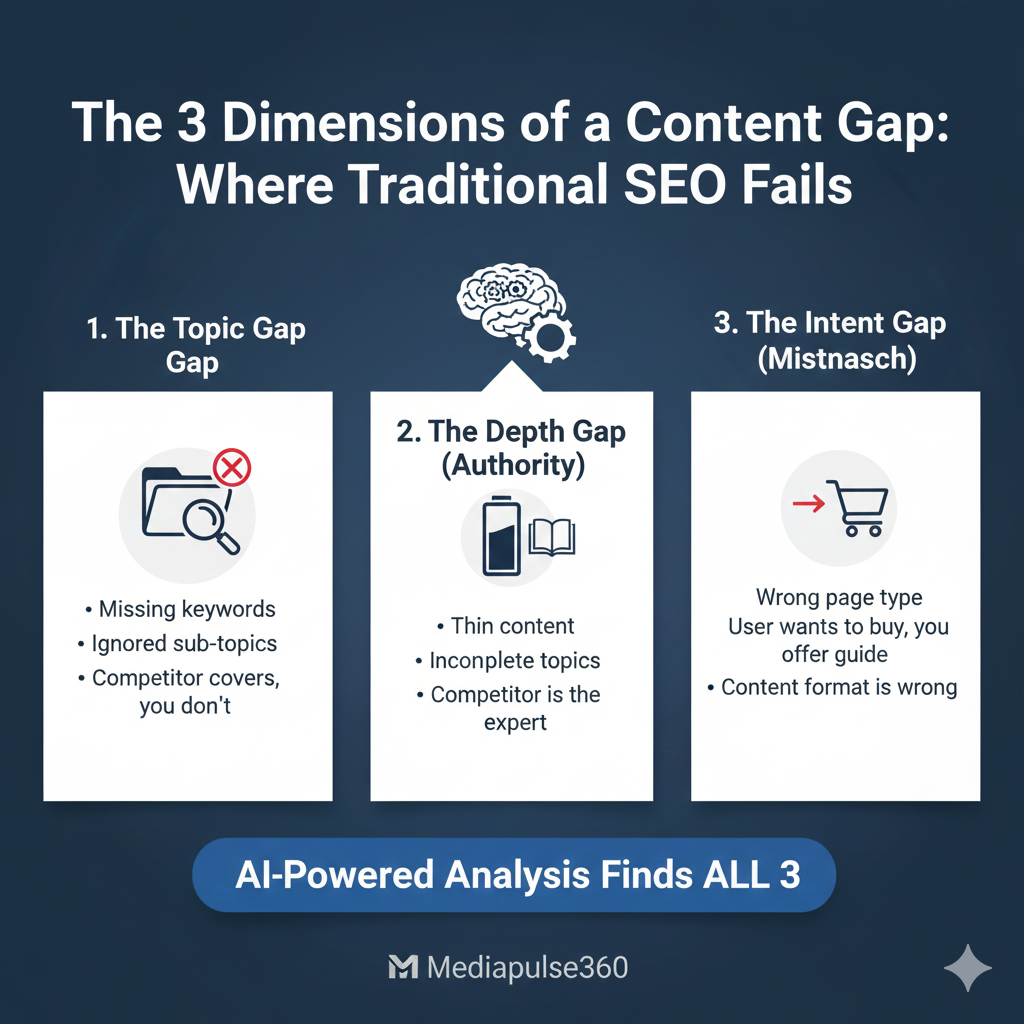
To accurately define the gap, AI assesses three critical areas:
- The Topic Gap: This is the most straightforward failure—you have simply omitted an entire sub-topic or theme that is essential for comprehensive coverage in your niche.
- The Depth Gap (Topical Authority): You have a page on the topic, but it is thin or outdated. Competitors have built topical authority by covering the subject much more deeply, including all related keywords and semantic entities.
- The Intent Gap: Your content exists, but its format is wrong. If a user is searching for a “transactional” keyword (e.g., best CRM software pricing), and your page is a general informational guide, you have an intent gap, and you will not rank.
Why Automate with AI? Time is Money, Insights are Gold.
AI is the ultimate productivity superpower for your content marketing. It eliminates the slow, manual steps, allowing you to focus purely on creating winning content—a shift that fundamentally changes your team’s ROI.
⚡️ Super-Fast Analysis: Time Savings That Are Unprecedented. AI sifts through millions of data points, comparing your entire content inventory against dozens of competitors in minutes—a task that would take a dedicated human team weeks. This reduction in overhead is directly convertible to increased content production.
🎯 Pinpoint Accuracy: Removing Human Bias and Error. Manual filtering often leads to errors or omissions (e.g., an analyst overlooking a valuable long-tail keyword). AI algorithms deliver precise insights, avoiding human fatigue and subject bias, ensuring every identified gap is a high-potential, validated opportunity.
🔄 Constant Monitoring: Staying Ahead of Content Decay. Your competitors are not static, and search results fluctuate daily. AI monitoring tools prevent content decay and provide continuous tracking. It instantly alerts you to new competitor content or ranking shifts, ensuring you are always operating with real-time data.
💡 Actionable Roadmaps: Data Translated into Strategy. AI doesn’t just deliver a raw data dump; the best tools automatically generate content briefs and suggested outlines. This translates raw insight into clear, actionable steps for your content team, eliminating the research and planning bottleneck.
🏆 Boosting E-E-A-T: AI helps identify exactly what elements are missing to achieve high scores in Google’s E-E-A-T (Experience, Expertise, Authoritativeness, and Trustworthiness). By filling the depth and topical gaps, you satisfy this critical ranking factor.
Your 5-Step AI Workflow to Content Gap Mastery
Here’s the detailed blueprint for how to put AI to work, turning competitor weaknesses into your strengths:
Step 1: Intelligent Competitor & Niche Identification
Don’t just plug in the three biggest names in your niche. Use AI to discover who is truly competing for your audience’s attention across all platforms.
- Primary Tool Function: Use SEMrush’s “Organic Research” or Ahrefs’ “Site Explorer” to analyze the top 10 ranking sites for your core 5-10 seed keywords.
- Niche Discovery: Expand beyond Google. Use AI listening tools (like BuzzSumo or Mention) to identify authoritative voices and niche content creators gaining traction on social media, forums (like Reddit/Quora), and industry newsletters.
- The Intent Filter: Segment competitors based on their primary content type: Do they focus on transactional pages (e.g., e-commerce)? Or informational guides (e.g., educational blogs)? This helps you match the correct type of content in the next step.
Step 2: Automated Crawl, Comparison, and Data Extraction
This is the core execution phase where AI tools do the heavy lifting of comparison.
- Tools Used: Ahrefs, SEMrush, Moz, SpyFu—each offering a slightly different perspective on the data.
- The Deep Crawl: AI SEO suites rapidly crawl and compare your content inventory against dozens of competitors. The key is pulling the “Missing Keywords” report and the “Top Pages” report. The latter highlights which individual competitor pages are attracting the most traffic and authority, providing a blueprint for content structure.
- What AI Highlights: It highlights exactly what keywords, entire topical clusters, and high-ranking pages are missing from your current strategy compared to the top performers in your industry.
Step 3: Prioritization and Deep Intent Analysis
You will have thousands of missing keywords. AI helps you prioritize the 1% that matters most for quick wins and long-term authority.
- Difficulty Scoring: Filter keywords by difficulty score (aim for a lower score for quick wins, or target high difficulty if the volume/value is immense).
- Search Intent Mapping: This is the most crucial manual/AI crossover point. For each high-priority keyword, analyze the current SERP (Search Engine Results Page). Does Google show product pages, listicles, or specific guides? Use AI to classify the user intent (Informational, Navigational, Transactional, Commercial Investigation) and ensure your planned content type matches it exactly.
- Value Assessment: Assign a rough commercial value to the keyword. A transactional keyword (“best project management software pricing”) is worth more than a purely informational one (“what is project management?”).
Step 4: Structuring the Optimized Content Brief
The output of the content gap analysis should not be a spreadsheet; it should be a highly structured content brief ready for the writer.
- AI Brief Generation: Tools like Surfer SEO, Frase, and Clearscope take the chosen target keyword and instantly analyze the top 10 competitors’ content.
Required Elements: The brief must include:
- Target Word Count: Based on the average of top-ranking competitors.
- Mandatory H2/H3 Tags: Generated by NLP to ensure all relevant sub-topics are covered.
- LSI & Semantic Keywords: A checklist of 20-30 related terms and entities that must be included to prove topical depth.
- Audience Questions: The “People Also Ask” and forum questions the content must answer.
Step 5: Continuous Monitoring and Strategy Refinement
The initial analysis is just the start. The AI must be kept on the job for continuous competitive vigilance.
- Automated Alerts: Set up email or dashboard alerts for when competitors publish new high-performing content or when your new content enters the top 10.
- Content Decay Tracking: Monitor your existing top pages for ranking decay. AI can alert you when a competitor’s new piece of content causes your page to drop, signaling an immediate need for content refresh and optimization.
- Strategy Review: Schedule a full competitive landscape review quarterly. AI will flag new emerging trends, technological shifts, and new competitor entrants that require a formal strategy adjustment.
Claim Your Traffic: It’s Time to Act on AI Insights
The secret to winning online is simple: you must publish the most helpful content in the best way possible. AI content gap analysis is the tool that makes sure every piece of writing you create is valuable and works hard to bring business your way.
Stop wasting time on content that gets ignored. It’s time to use the power of AI to instantly find the weak spots in your competitors’ plans and take over their traffic.
Ready for Your Free Expert Content Consultation?
Don’t spend one more minute struggling with hard-to-use software and complicated data.
Let the experts at Mediapulse360, your full-service digital marketing agency, handle all the difficult research for you. Our Content Marketing Services are built on smart AI insights, which guarantees that every piece of content you create brings in maximum customers and sales possible.
👉 Next Read: The Top 10 Digital Marketing Books Every Strategist MUST Read
